Our New FDA-Approved Treatment: Learn More

Phase 2, multicenter, randomized clinical study to evaluate the efficacy and safety of safusidenib in patients with high-grade isocitrate dehydrogenase 1 (IDH1)-mutant glioma

David A. Reardon,1 Yoshie Umemura,2 Katherine B. Peters,3 Ying Mao,4 Yuling Cen,5 Jianxin Wei,5 Piia Thomas,5 Fabio Iwamoto6

1Center for Neuro-Oncology, Dana-Farber Cancer Institute, Boston, MA, USA; 2Division of Neuro-Oncology, Ivy Brain Tumor Center, Barrow Neurological Institute, Phoenix, AZ, USA; 3Department of Neurosurgery, Duke University Medical Center, Durham, NC, USA; 4Department of Neurosurgery, Huashan Hospital, Fudan University, Shanghai, China; 5Nuvation Bio Inc., New York, NY, USA; 6Department of Neurology, Columbia University Irving Medical Center, New York, NY, USA

Presented at the 7th Quadrennial Meeting of the World Federation of Neuro-Oncology Societies (WFNOS) and 30th Annual Meeting & Education Day of the Society for Neuro-Oncology (SNO) | November 19-23, 2025 | Honolulu, HI, USA

Previously presented at CNS 2025: the 22nd Academic Conference of the Chinese Society of Neurosurgery | August 7-9, 2025 | Suzhou, Jiangsu Province, China

Jump to a section:

Purpose

NCT05303519 is a currently recruiting, phase 2, global, randomized clinical study in patients with IDH1-mutant grade 3 and grade 4 astrocytoma that will evaluate the efficacy and safety of safusidenib as maintenance treatment (250 mg PO BID) after SOC radiation or chemoradiation and adjuvant TMZ treatment

Background

  • IDH1-mutant astrocytomas (including grades 2-4) are recognized as a distinct entity by the WHO CNS 2021 classification based on their unique molecular and clinical features1
  • Standard of care for grade 3/4 IDH1-mutant astrocytoma includes maximal safe resection followed by RT or chemoradiation and adjuvant TMZ2,3
    • While this treatment is effective at prolonging PFS, all patients will eventually progress, at which point salvage therapies provide nominal benefit4,5
  • There is a clear unmet need for the treatment of patients with grade 3/4 IDH1-mutant astrocytoma to delay progression after current standard therapy2,3,6,7
  • No targeted treatment is currently approved for grade 3/4 IDH1-mutant glioma
  • Safusidenib, a novel, potent, oral mutant IDH1 inhibitor with high blood-brain barrier permeability, demonstrated promising phase 1 activity in patients with recurrent or progressive high-grade and contrast-enhancing IDH1-mutant glioma (NCT03030066)8
    • The ORRs were 17.1% for enhancing tumors and 33.3% for nonenhancing tumors
      • This response rate is higher than response rates seen with other IDH inhibitors in enhancing glioma (ORR of 8% [2 PRs] with olutasidenib,9 ORRs of 0% with ivosidenib10 and vorasidenib11)
    • In the 35 enhancing tumors assessed by RANO, there were 2 CRs and 4 PRs
    • Responses were durable, with 1 patient with grade 4 IDH1-mutant astrocytoma having a CR lasting approximately 174 weeks
    • Further development of safusidenib in high-grade IDH1-mutant glioma is warranted

Methods

  • This is a currently enrolling phase 2, global, randomized clinical study (NCT05303519), evaluating the efficacy and safety of safusidenib in patients with IDH1-mutant glioma
    • A protocol amendment is in progress to make this a phase 3 registrational study with an increased sample size (from N≈100 to N≈300)
  • The study includes the following 2 parts:
    • Part 1 assessed safusidenib in patients in the US with grade 2/3 IDH1-mutant glioma and completed enrollment in December 2023
    • Here, we present the study design of part 2 that will assess safusidenib in patients with IDH1-mutant grade 3 and grade 4 astrocytoma (Figure 1)
  • Approximately 300 adult patients from up to 50 sites in China, Australia, and the US will be randomized
  • Randomization will be stratified by:
    • CDKN2A/B homozygous deletion
    • Resection status after the most recent surgery per investigator assessment
    • Tumor grade per investigator assessment
  • Patients will receive safusidenib (250 mg PO BID) or placebo after SOC RT or chemoradiation and ≥6 cycles (maximum of 12 cycles) of adjuvant TMZ
  • Key eligibility criteria and endpoints are listed in Figure 1
  • Recruitment for the study is ongoing
Figure 1. Study Design
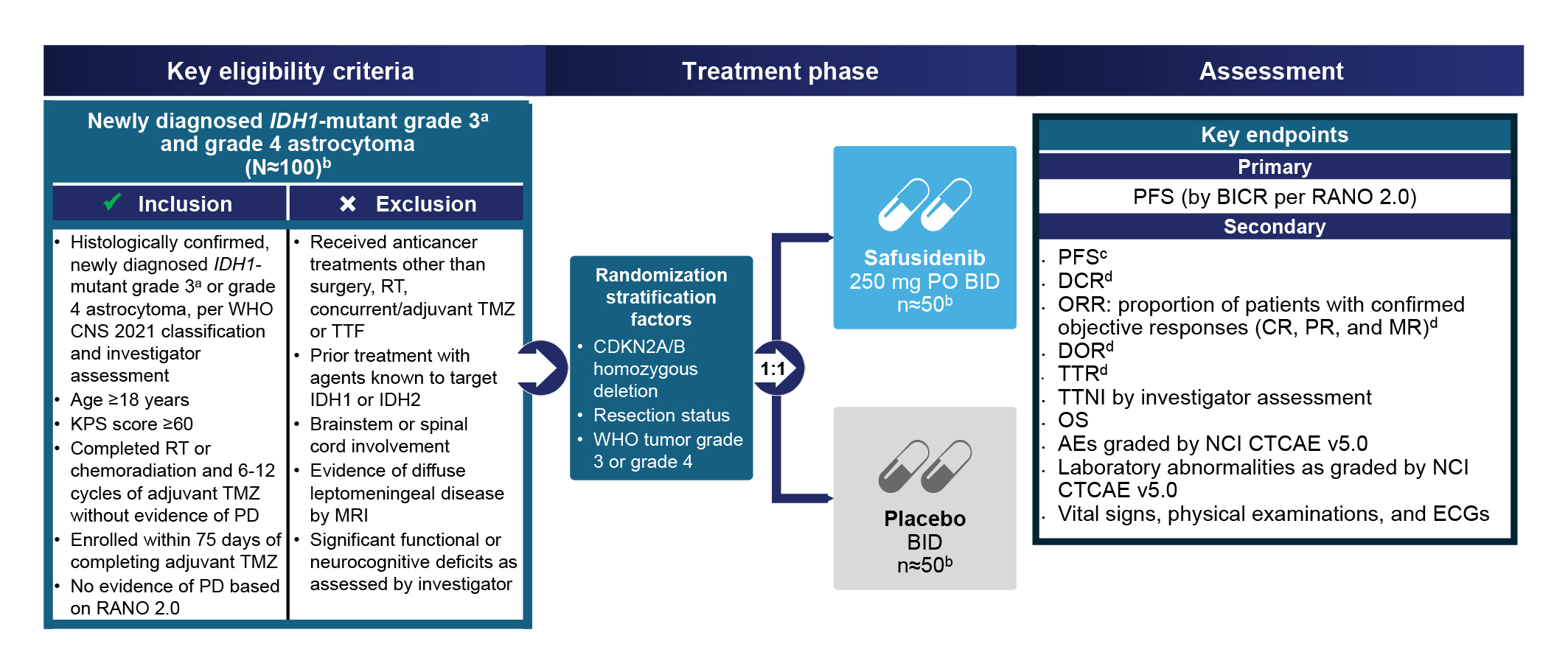
aPatients with grade 3 astrocytoma are included if they have one or more “high-risk” features described in the protocol. bA protocol amendment is in progress to make this a phase 3 registrational study with an increased sample size (from N≈100 to N≈300, with ~150 participants in each arm). cAssessed by the investigator per RANO 2.0. dAssessed by BICR and the investigator per RANO 2.0.

Abbreviations

AE, adverse event; BICR, Blinded Independent Central Review; BID, twice daily; CNS, central nervous system; CR, complete response; DCR, disease control rate; DOR, duration of response; ECG, electrocardiogram; IDH1, isocitrate dehydrogenase 1; KPS, Karnofsky Performance Status; MR, minor response; MRI, magnetic resonance imaging; NCI CTCAE, National Cancer Institute Common Terminology Criteria for Adverse Events; ORR, objective response rate; OS, overall survival; PD, progressive disease; PFS, progression-free survival; PO, oral administration; PR, partial response; RANO, Response Assessment in Neuro-Oncology; RT, radiation therapy; SOC, standard of care; TMZ, temozolomide; TTF, tumor treating fields; TTNI, time to next intervention; TTR, time to response; US, United States; WHO, World Health Organization.

References

  1. Louis DN, et al. Neuro Oncol. 2021;23:1231-1251.
  2. Lin DM, et al. NPJ Precis Oncol. 2024;8:149.
  3. Mohile NA, et al. J Clin Oncol. 2022;40:403-426.
  4. Minniti G, et al. J Neurooncol. 2023;164:331-339.
  5. Lally AR, et al. J Neurooncol. 2025;174:167-175.
  6. Ma S, et al. Neurooncol Adv. 2021;3:vdab081.
  7. Weller M, et al. Nat Rev Clin Oncol. 2021;18:170-186.
  8. Natsume A, et al. Neuro Oncol. 2023;25:326-336.
  9. de la Fuente MI, Neuro Oncol. 2023;25(1):146-156.
  10. Mellinghoff IK, Clin Oncol. 2020;38(29):3398-3406.
  11. Mellinghoff IK, et al. Clin Cancer Res. 2021;27(16):4491-4499.

Acknowledgments

  • We would like to thank all patients who participated in this study, the study investigators, and their staff
  • This study was sponsored by Nuvation Bio Inc. All authors contributed to and approved the presentation; writing and editorial assistance were provided by Nikola Vojtov, PhD, and Alanna Kennedy, PhD, CMPP, of The Lockwood Group (Stamford, CT, USA), funded by Nuvation Bio Inc.

Explore our other publications