Our New FDA-Approved Treatment: Learn More

Taletrectinib vs Entrectinib in ROS1-Positive Non-Small Cell Lung Cancer: A Matching-Adjusted Indirect Comparison

Misako Nagasaka,1 Geoffrey Liu,2 Nathan A. Pennell,3 Maurice Pérol,4 Wenfeng Chen,5 Lyudmila Bazhenova,6 Caicun Zhou7

1University of California Irvine School of Medicine and Chao Family Comprehensive Cancer Center, Orange, CA, USA; 2Princess Margaret Cancer Centre, Temerty School of Medicine, University of Toronto, Toronto, Canada; 3Taussig Cancer Institute, Cleveland Clinic Cancer Center, Cleveland, OH, USA; 4Centre Léon Bérard, Lyon, France; 5Nuvation Bio, New York, NY, USA; 6University of California San Diego Moores Cancer Center, San Diego, CA, USA; 7Shanghai Pulmonary Hospital and Thoracic Cancer Institute, Tongji University School of Medicine, Shanghai, China

Presented at the International Society for Pharmacoeconomics and Outcomes Research Congress | May 13-16, 2025 | Montreal, Quebec, CA

Jump to a section:

Background

  • For patients with ROS1+ NSCLC, ROS1 tyrosine kinase inhibitors (TKIs) are the current standard of care1
  • Entrectinib was approved by the US Food and Drug Administration in 2019 and crosses the blood-brain barrier, but overall responses were marginal in patients with prior CNS progression (IC-ORR: 11%) 2,3
  • Taletrectinib is an oral, potent, CNS-active, selective, next-generation, ROS1 inhibitor 4-6
      • Taletrectinib has demonstrated high and durable overall and IC response rates, activity against G2032R, and a favorable safety profile in the pivotal regional TRUSTI (NCT04395677) and global TRUST-II (NCT04919811) studies 6,7
      • In December 2024, the US FDA granted priority review to the NDA for seeking the approval of taletrectinib for the treatment of advanced ROS1+ NSCLC (PDUFA goal date of June 23, 2025)
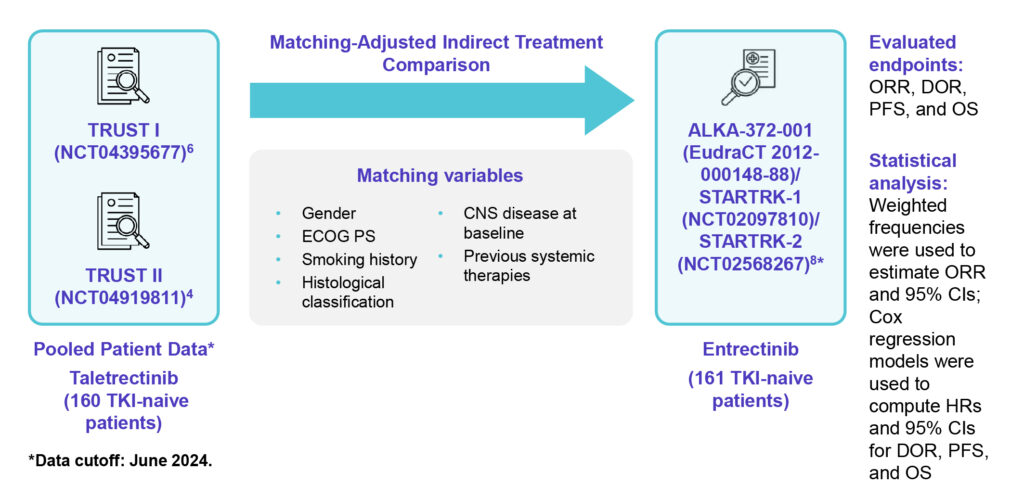
  • In the absence of head-to-head trials in TKI-naive patients with ROS1+ NSCLC, we compared taletrectinib with the first-generation TKI, entrectinib, using a MAIC analysis

Objective

To conduct a matching-adjusted indirect comparison (MAIC) of taletrectinib and entrectinib in TKI-naive patients with ROS1+ NSCLC

Methods

Study Design

Results

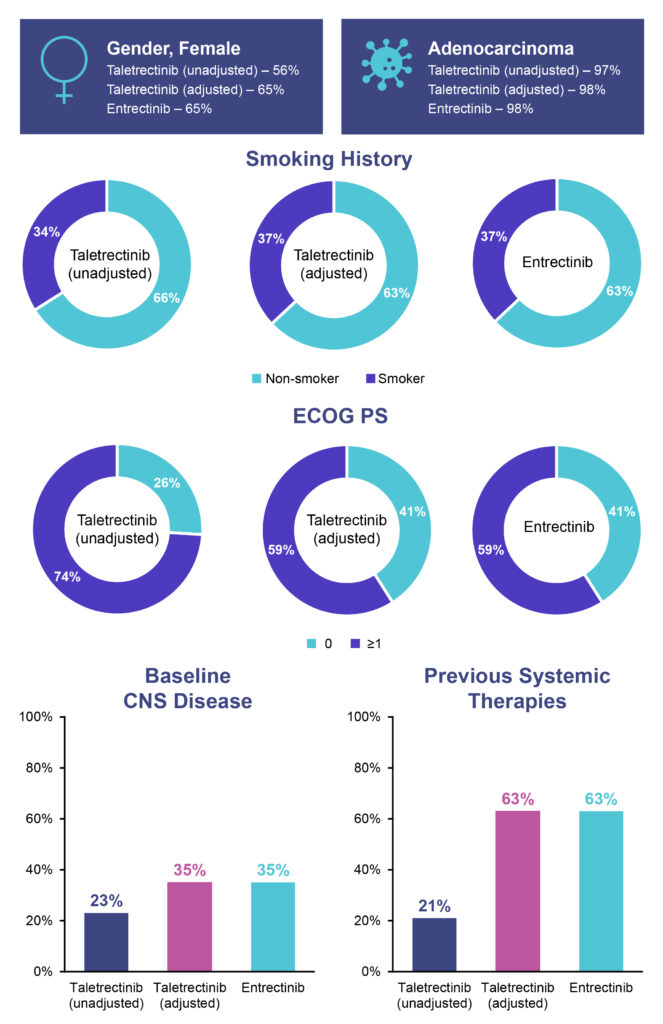
Baseline Comparison in ROS1+ TKI-Naive NSCLC
 

ORR in ROS1+ TKI-Naive NSCLC
 

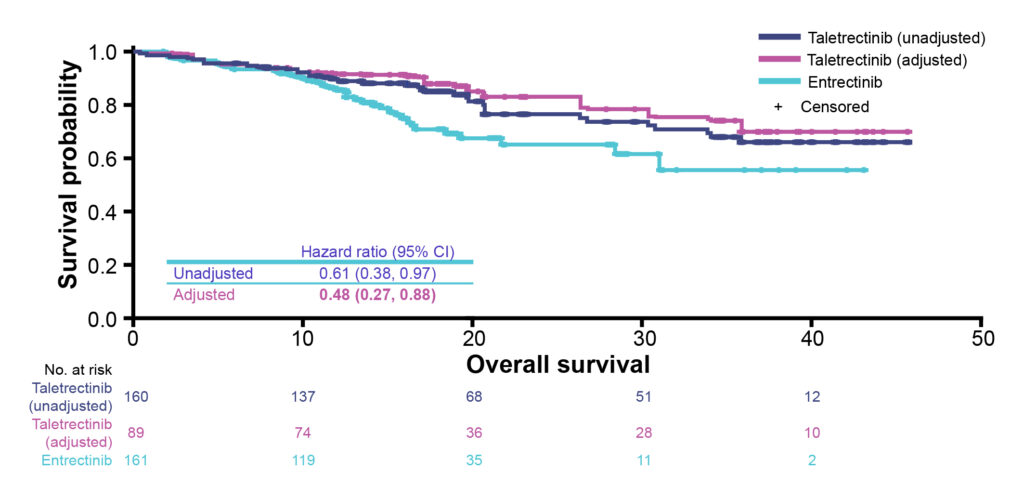
OS for ROS1+ TKI-Naive Group
 

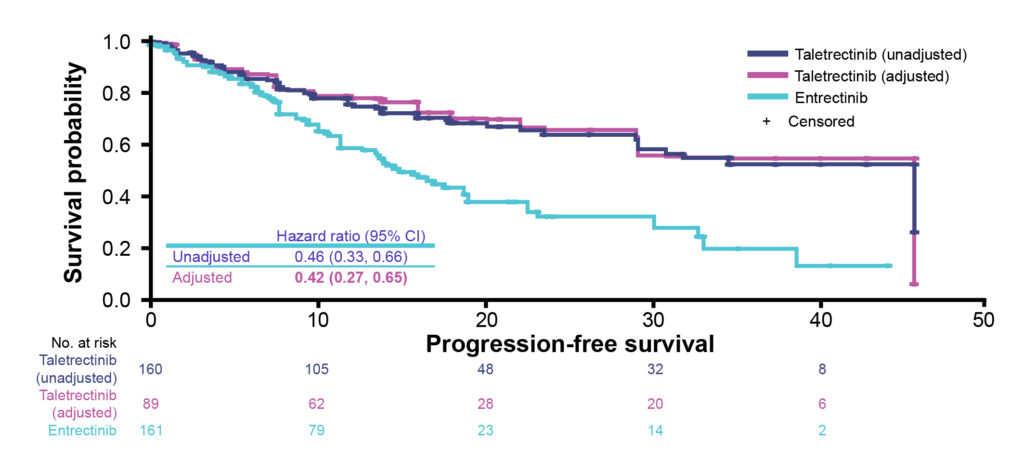
PFS for ROS1+ TKI-Naive Group
 

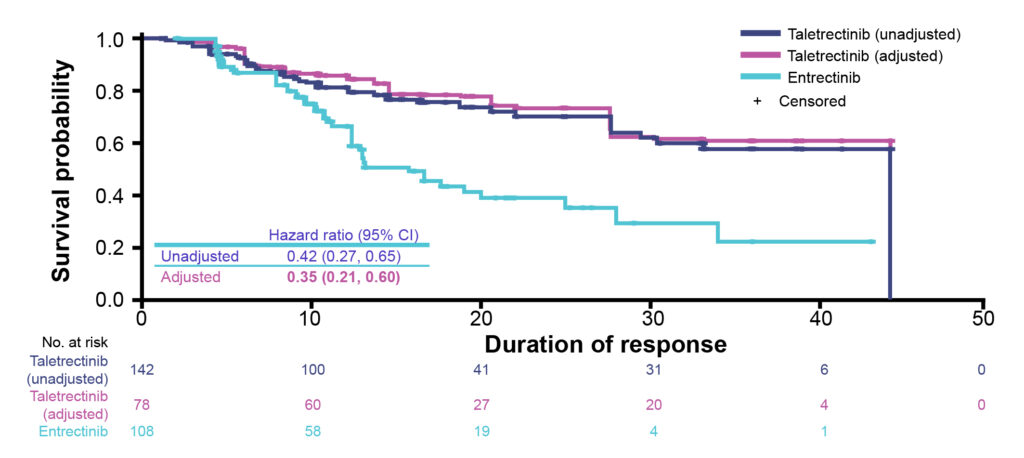
DOR for ROS1+ TKI-Naive Group
 

Safety in ROS1+ NSCLC
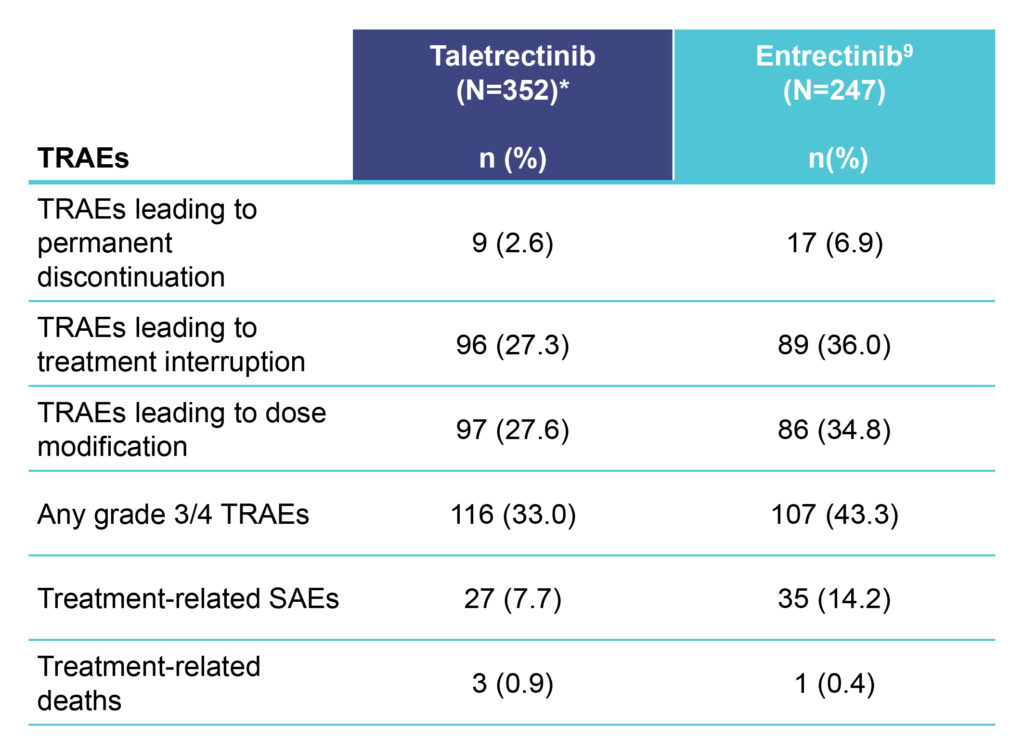
*Pooled safety population included all patients receiving taletrectinib 600 mg once daily until disease progression or unacceptable toxicity across the safety population10

  • TRAE rates are summarized for taletrectinib and entrectinib
  • Due to the inconsistent definition of TRAEs, as well as lack of availability of baseline patient characteristics of comparable safety population, these estimates are unadjusted and not designed for drawing comparisons between agents


Limitations and Strengths

  • Indirect treatment comparison studies are subject to bias due to variations in patient populations, study designs, and outcome measures across the included trials, leading to uncertain comparisons
  • Given the available evidence, the described comparative analysis is a transparent and methodologically sound approach to compare taletrectinib and entrectinib

Conclusions

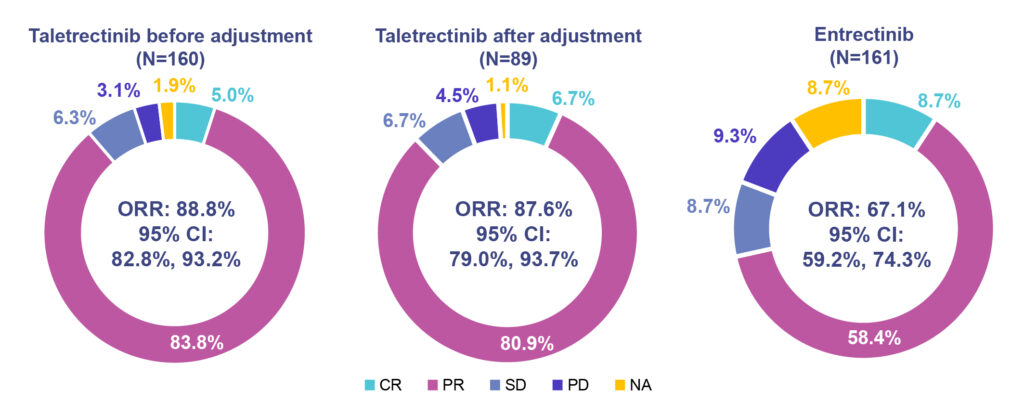
Taletrectinib showed significantly improved efficacy outcomes vs entrectinib in TKI-naive patients with ROS1+ NSCLC in the MAIC analysis, including

  • Higher ORR and a significant 65% improvement in the likelihood of maintaining a response
  • Significant 52% reduction in the risk of death and a 58% reduction in the risk of progression/death

TRAEs are summarized as unadjusted estimates, since the lack of comparable baseline characteristics limits comparison across treatments

These findings underscore the therapeutic benefits of taletrectinib over entrectinib outside of head-to-head randomized controlled trials

Abbreviations

CNS, central nervous system; CR, complete response; DOR, duration of response; ECOG PS, Eastern Cooperative Oncology Group performance status; IC, intracranial; MAIC, matching-adjusted indirect comparison; NA, not available; NDA, New Drug Application; NSCLC, non-small cell lung cancer; ORR, objective response rate; OS, overall survival; PD, progressive disease; PDUFA, Prescription Drug User Fee Act; PFS, progression-free survival; PR, partial response; PT, preferred term; ROS1+, ROS1-positive; SAE, serious adverse events; SD, stable disease; TKI, tyrosine kinase inhibitor; TRAE, treatment-related adverse event; US FDA, US Food and Drug Administration.

References

  1. Gendarme S, et al. Curr Oncol. 2022;29:641-658.
  2. Rozlytrek [package insert]. San Francisco, CA: Genentech USA, Inc; October 2023.
  3. Drilon A, et al. JTO Clin Res Rep. 2022;3:100332.
  4. Nagasaka M, et al. Future Oncol. 2023;19:123-135.
  5. Katayama R, et al. Nat Comm. 2019;10:3604.
  6. Li W, et al. J Clin Oncol. 2024;42:2660-2670.
  7. Liu, et al. JTO. 2024;10:S72-S73.
  8. Drilon A, et al. Lancet Oncol. 2020;21:261-270.
  9. Fan Y, et al. Clin Lung Cancer. 2024;25:e81-e86.e4.
  10. Perol M, et al. JCO. 2025.

Acknowledgments

  • We would like to thank all patients who participated in this study, the study investigators, and their staff
  • This study was sponsored by Nuvation Bio, Inc. Writing and graphical support were provided by Tulika Bhushan Bahukhandi, RPh, MS, of Peloton Advantage, LLC, an OPEN Health company, and funded by Nuvation Bio

Explore our other publications