Taletrectinib Across Key Subgroups in Patients With ROS1+ Non-Small Cell Lung Cancer: Results From TRUST-I and TRUST-II
Hidetoshi Hayashi,1 Jessica J. Lin,2 Chang-Min Choi,3 Maurice Pérol,4 Yongchang Zhang,5 Lyudmila Bazhenova,6 Jorge Nieva,7 Huijie Fan,8 Misako Nagasaka,9 Qitao Yu,10 Sara Cresta,11 Feiwu Ran,12 Wei Wang,12 Xianyu Zhang,12 Wei Li,13 Geoffrey Liu,14 Caicun Zhou15
1Kindai University Faculty of Medicine, Osaka, Japan; 2Mass General Brigham Cancer Institute, Boston, MA, USA; 3Asan Medical Center, University of Ulsan College of Medicine, Seoul, Republic of Korea; 4Léon Bérard Cancer Center, Lyon, France; 5Hunan Cancer Hospital, The Affiliated Cancer Hospital of Xiangya School of Medicine, Central South University, Changsha, China; 6UC San Diego Moores Cancer Center, San Diego, CA, USA; 7Norris Comprehensive Cancer Center, University of Southern California, Los Angeles, CA, USA; 8The First Affiliated Hospital of Zhengzhou University, Zhengzhou, China; 9University of California Irvine School of Medicine and Chao Family Comprehensive Cancer Center, Orange, CA, USA; 10Affiliated Tumor Hospital of Guangxi Medical University, Nanning, China; 11Fondazione IRCCS Istituto Nazionale dei Tumori, Milan, Italy; 12Nuvation Bio Inc., New York, NY, USA; 13Shanghai Pulmonary Hospital and Thoracic Cancer Institute, Tongji University School of Medicine, Shanghai, China; 14Princess Margaret Cancer Centre, Temerty School of Medicine, University of Toronto, Toronto, ON, Canada; 15Shanghai East Hospital and Thoracic Cancer Institute, Tongji University School of Medicine, Shanghai, China
Presented at the World Conference on Lung Cancer | September 12–15, 2026 | Seoul, Republic of Korea
For more information, please contact Dr Hidetoshi Hayashi: hidet31@med.kindai.ac.jp
Jump to a section:
Background
- Taletrectinib is a next-generation, CNS-active, selective ROS1 TKI approved in the United States, Japan, and China for patients with locally advanced or metastatic ROS1+ NSCLC1–5
- In the Phase 2 TRUST-I (NCT04395677) and TRUST-II (NCT04919811) studies, taletrectinib demonstrated robust and durable efficacy and a manageable safety profile in both TKI-naïve and TKI-pretreated patients with ROS1+ NSCLC6–8
- Additionally, taletrectinib has shown IC activity and efficacy against the acquired G2032R resistance mutation6–8
- Here we report updated data from TRUST-I and TRUST-II, including efficacy across key subgroups
Methods
- Study designs for TRUST-I and TRUST-II have been previously reported9
- The efficacy population included patients from TRUST-I and TRUST-II who started treatment on taletrectinib 600 mg QD and had
≥1 measurable baseline lesion per RECIST v1.1 by IRC - Safety was evaluated in patients with ROS1+ NSCLC enrolled in Phase 1 and Phase 2 studies who received ≥1 dose of taletrectinib 600 mg QD
Efficacy Analyses
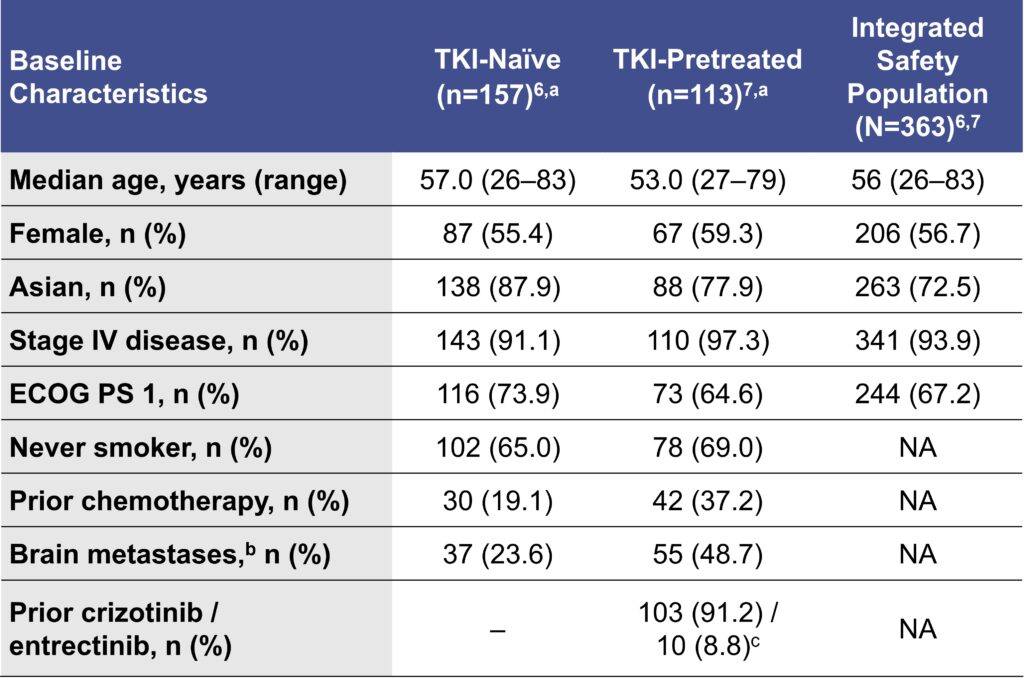
aTKI-naïve patients included 103 patients from TRUST-I and 54 patients from TRUST-II; TKI-pretreated patients included 66 patients from TRUST-I and 47 from the registrational cohort 2 of TRUST-II who received one prior TKI. bAssessed by IRC per mRECIST v1.1. cTwo patients were enrolled following crizotinib intolerance and 111 patients were enrolled following disease progression on a prior TKI.
Taletrectinib Demonstrated Robust and Durable Efficacy in TKI-Naïve and TKI-Pretreated Patients With ROS1+ NSCLC
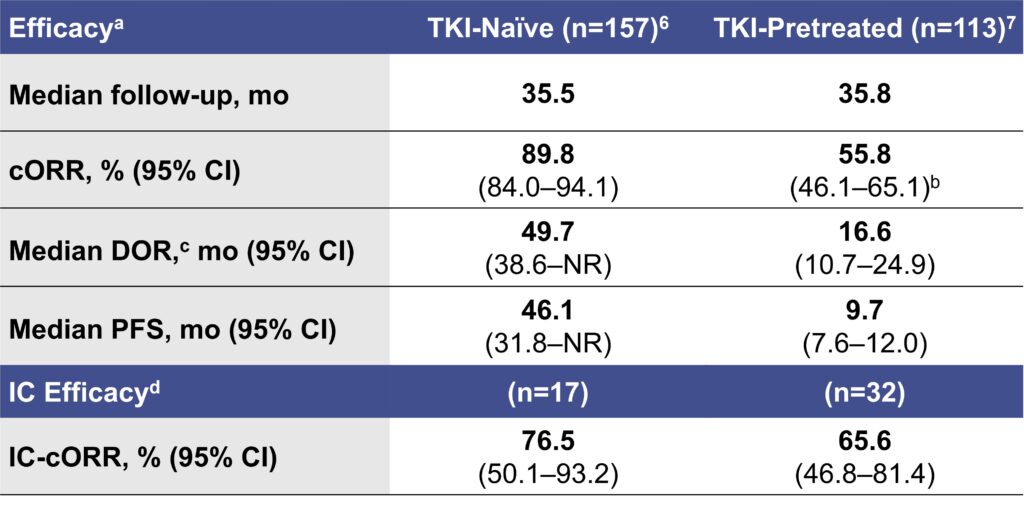
Data cutoff: August 31, 2025. aAssessed in patients with ≥1 measurable baseline lesion per RECIST v1.1 by IRC. bResponses were observed in 8/12 patients from TRUST-I with G2032R mutations (ORR 66.7% [95% CI 34.9–90.1]). cDOR reported only for patients with a complete or partial tumor response. dAssessed by IRC per mRECIST v1.1 in patients with ≥1 measurable baseline brain metastasis. Among these, three TKI-naïve patients from TRUST-II and 20 TKI-pretreated patients (eight from TRUST-I and 12 from TRUST-II) had previously received IC radiotherapy.
Efficacy Was Similar Regardless of Prior Chemotherapy
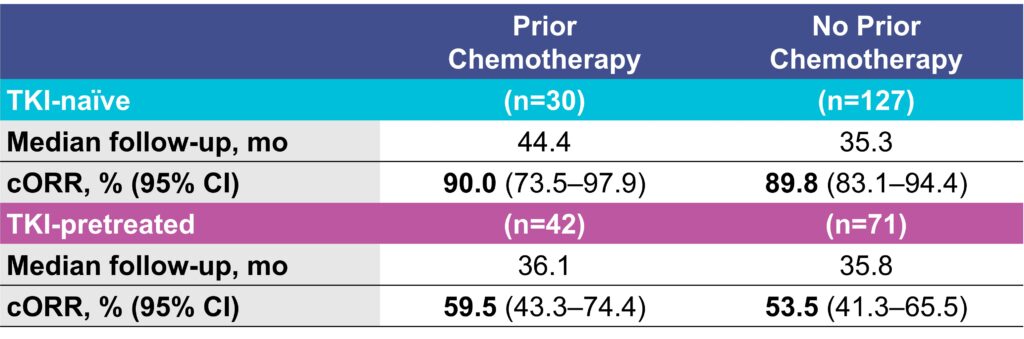
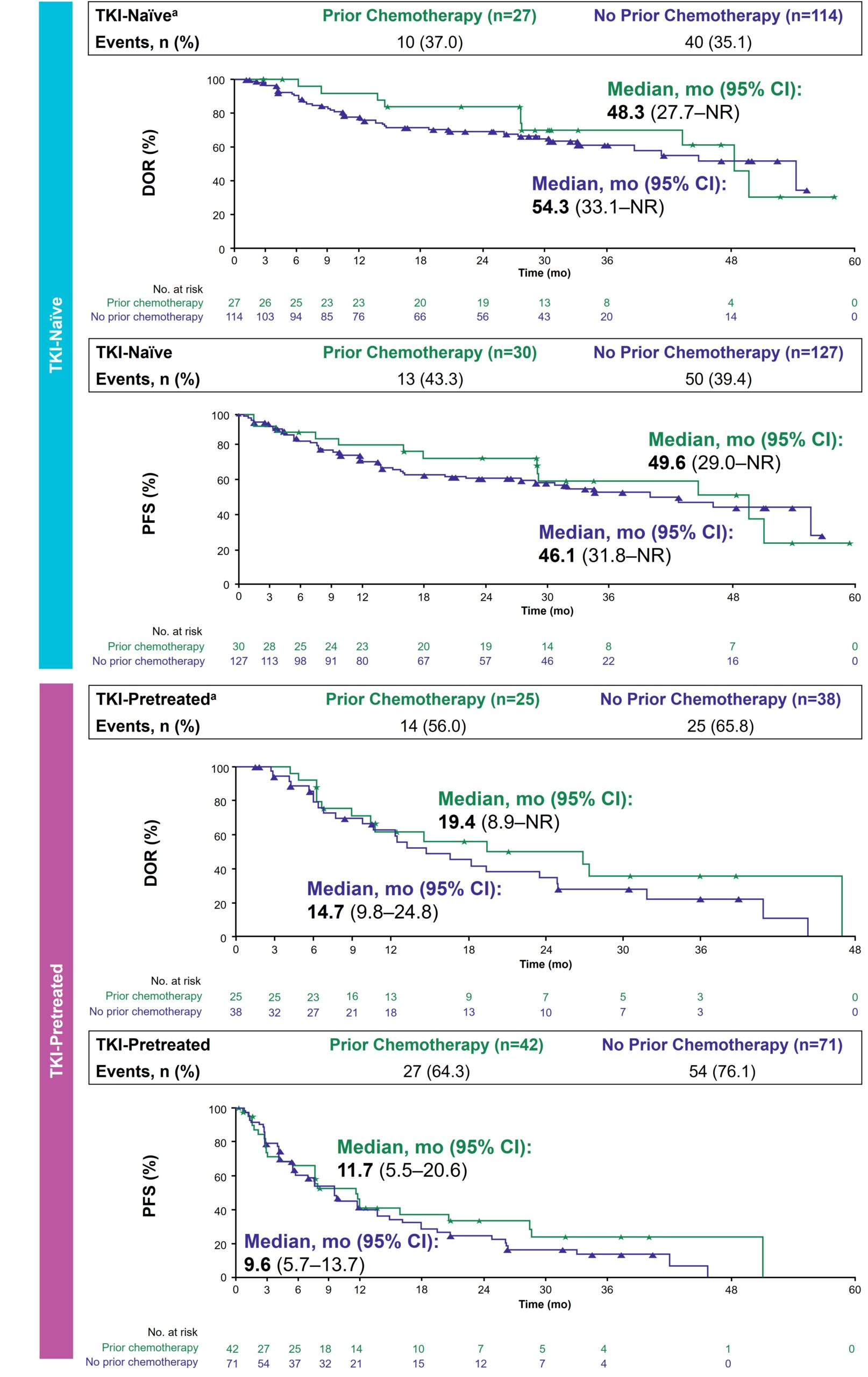
Data cutoff: August 31, 2025. aDOR reported only for patients with a complete or partial tumor response.
Efficacy Was Similar Regardless of ROS1 Fusion Partnera
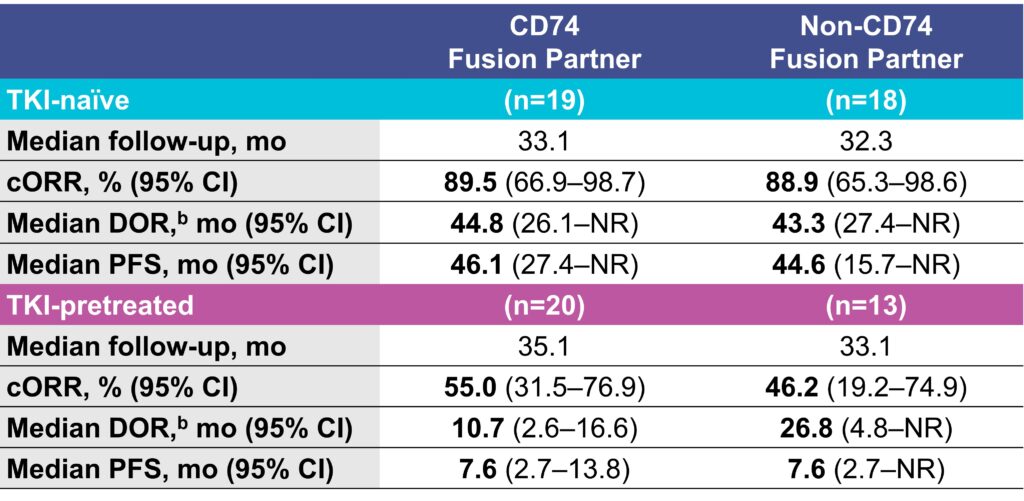
Data cutoff: August 31, 2025. aROS1 fusion partners were assessed by tissue-based NGS where available. bDOR reported only for patients with a complete or partial tumor response.
Integrated Safety Analysis (N=363)
- As of August 31, 2025, the integrated safety population included 363 TKI-naïve and TKI-pretreated patients with ROS1+ NSCLC from Phase 1 and Phase 2 studies who received ≥1 dose of taletrectinib 600 mg QD6,7
- With longer follow-up, taletrectinib demonstrated a manageable safety profile consistent with prior reports, with no new safety signals identified
- The most common (any-grade) TEAEs were increased AST, increased ALT, diarrhea, nausea, and vomiting, which were mostly low grade
- TEAEs led to dose interruptions in 42.7% of patients, dose reductions in 31.3%, and treatment discontinuations in 8.5%
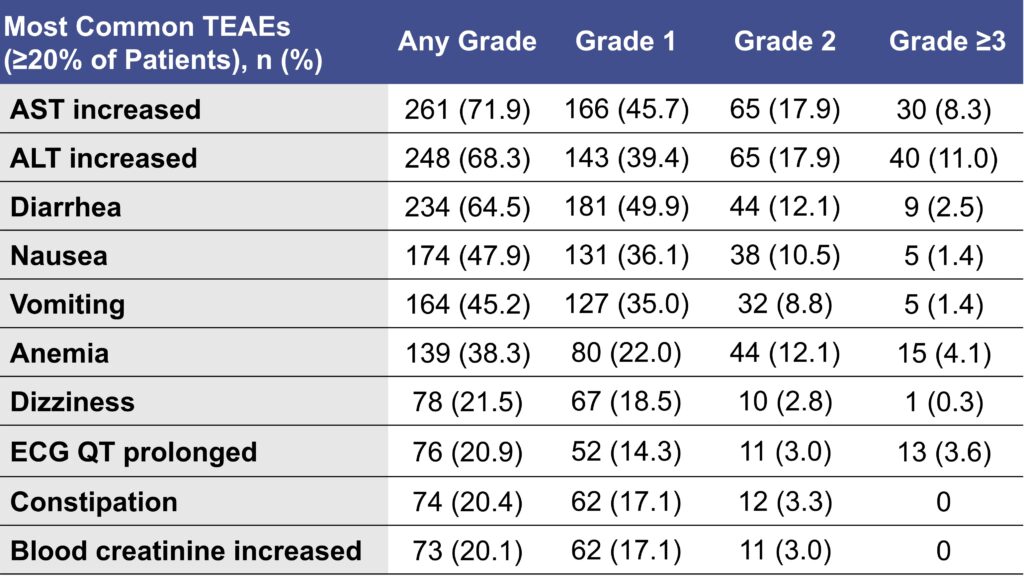
Data cutoff: August 31, 2025.
Conclusions
- With almost 3 years of follow-up, taletrectinib demonstrated high and durable response rates in both TKI-naïve and TKI-pretreated patients with ROS1+ NSCLC
- Subgroup analyses indicated similar efficacy regardless of prior chemotherapy exposure or ROS1 fusion partners
- With longer follow-up, taletrectinib continued to show a manageable safety profile, with no new safety signals identified
Abbreviations
ALT, alanine aminotransferase; AST, aspartate aminotransferase; c, confirmed; CI, confidence interval; CNS, central nervous system; DOR, duration of response; ECG, electrocardiogram; ECOG PS, Eastern Cooperative Oncology Group performance status; IC, intracranial; IRC, independent review committee; (m)RECIST v1.1, (modified) Response Evaluation Criteria in Solid Tumors version 1.1; mo, months; NA, not available; NGS, next-generation sequencing; NR, not reached; NSCLC, non-small cell lung cancer; ORR, objective response rate; PFS, progression-free survival; ROS1, ROS1 proto-oncogene 1; TEAE, treatment-emergent adverse event; TKI, tyrosine kinase inhibitor.
References
- Katayama R, et al. Nat Commun 2019;10:3604
- Nagasaka M, et al. Future Oncol 2023;19:123–135
- IBTROZI® (taletrectinib). Prescribing Information. Nuvation Bio Inc. 2025
- Nippon Kayaku. IBTROZI® Capsules 200mg (taletrectinib) has been approved in Japan. Accessed June 05, 2026; https://www.nipponkayaku.co.jp/english/news/detail.php?n=20250919_6G5AI1Y7
- Nuvation Bio. Nuvation Bio Receives Approval from China’s NMPA for Taletrectinib. Accessed June 05, 2026; https://investors.nuvationbio.com/news/news-details/2025/Nuvation-Bio-Receives-Approval-from-Chinas-National-Medical-Products-Administration-for-Taletrectinib-for-Patients-with-Advanced-ROS1-positive-Non-Small-Cell-Lung-Cancer
- Bazhenova L, et al. Cancer Res 2026;86(8_Suppl):CT300
- Liu G, et al. Cancer Res 2026;86(8_Suppl):CT244
- Li W, et al. J Clin Oncol 2026;44:1670–1675
- Pérol M, et al. J Clin Oncol 2025;43:1920–1929
Acknowledgments
We would like to thank all patients who participated in these studies, the study investigators, and their staff. These studies were sponsored by Nuvation Bio Inc. Medical writing support was provided by Lisa Alberts, MPhil, of Ashfield MedComms, an Inizio company, and was funded by Nuvation Bio Inc.