Phase 2, multicenter, randomized clinical study to evaluate the efficacy and safety of safusidenib in patients with high-grade isocitrate dehydrogenase 1 (IDH1)-mutant glioma
David A. Reardon,1 Yoshie Umemura,2 Katherine B. Peters,3 Ying Mao,4 Yuling Cen,5 Jianxin Wei,5 Piia Thomas,5 Fabio Iwamoto6
1Center for Neuro-Oncology, Dana-Farber Cancer Institute, Boston, MA, USA; 2Division of Neuro-Oncology, Ivy Brain Tumor Center, Barrow Neurological Institute, Phoenix, AZ, USA; 3Department of Neurosurgery, Duke University Medical Center, Durham, NC, USA; 4Department of Neurosurgery, Huashan Hospital, Fudan University, Shanghai, China; 5Nuvation Bio Inc., New York, NY, USA; 6Department of Neurology, Columbia University Irving Medical Center, New York, NY, USA
Presented at the 7th Quadrennial Meeting of the World Federation of Neuro-Oncology Societies (WFNOS) and 30th Annual Meeting & Education Day of the Society for Neuro-Oncology (SNO) | November 19-23, 2025 | Honolulu, HI, USA
Previously presented at CNS 2025: the 22nd Academic Conference of the Chinese Society of Neurosurgery | August 7-9, 2025 | Suzhou, Jiangsu Province, China
Jump to a section:
Purpose
NCT05303519 is a currently recruiting, phase 2, global, randomized clinical study in patients with IDH1-mutant grade 3 and grade 4 astrocytoma that will evaluate the efficacy and safety of safusidenib as maintenance treatment (250 mg PO BID) after SOC radiation or chemoradiation and adjuvant TMZ treatment
Background
- IDH1-mutant astrocytomas (including grades 2-4) are recognized as a distinct entity by the WHO CNS 2021 classification based on their unique molecular and clinical features1
- Standard of care for grade 3/4 IDH1-mutant astrocytoma includes maximal safe resection followed by RT or chemoradiation and adjuvant TMZ2,3
- While this treatment is effective at prolonging PFS, all patients will eventually progress, at which point salvage therapies provide nominal benefit4,5
- There is a clear unmet need for the treatment of patients with grade 3/4 IDH1-mutant astrocytoma to delay progression after current standard therapy2,3,6,7
- No targeted treatment is currently approved for grade 3/4 IDH1-mutant glioma
- Safusidenib, a novel, potent, oral mutant IDH1 inhibitor with high blood-brain barrier permeability, demonstrated promising phase 1 activity in patients with recurrent or progressive high-grade and contrast-enhancing IDH1-mutant glioma (NCT03030066)8
- The ORRs were 17.1% for enhancing tumors and 33.3% for nonenhancing tumors
- This response rate is higher than response rates seen with other IDH inhibitors in enhancing glioma (ORR of 8% [2 PRs] with olutasidenib,9 ORRs of 0% with ivosidenib10 and vorasidenib11)
- In the 35 enhancing tumors assessed by RANO, there were 2 CRs and 4 PRs
- Responses were durable, with 1 patient with grade 4 IDH1-mutant astrocytoma having a CR lasting approximately 174 weeks
- Further development of safusidenib in high-grade IDH1-mutant glioma is warranted
- The ORRs were 17.1% for enhancing tumors and 33.3% for nonenhancing tumors
Methods
- This is a currently enrolling phase 2, global, randomized clinical study (NCT05303519), evaluating the efficacy and safety of safusidenib in patients with IDH1-mutant glioma
- A protocol amendment is in progress to make this a phase 3 registrational study with an increased sample size (from N≈100 to N≈300)
- The study includes the following 2 parts:
- Part 1 assessed safusidenib in patients in the US with grade 2/3 IDH1-mutant glioma and completed enrollment in December 2023
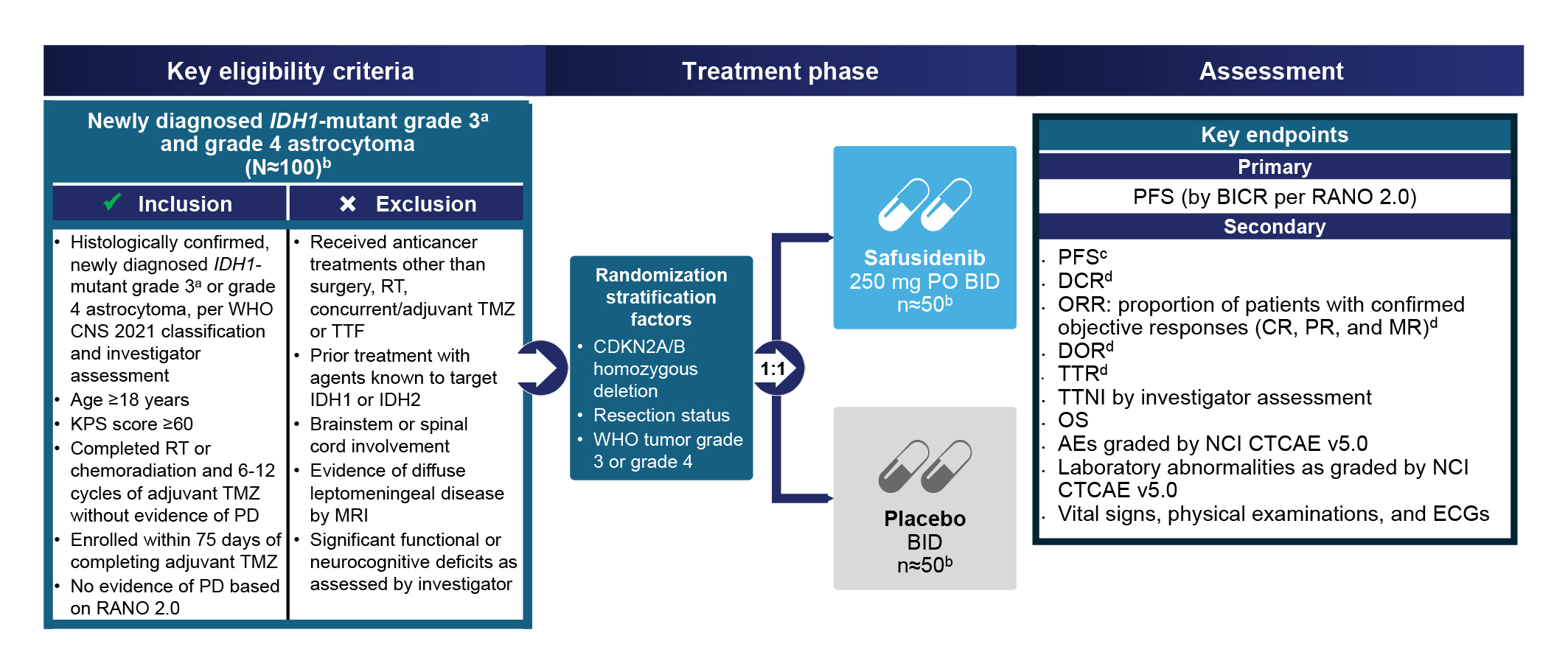
- Here, we present the study design of part 2 that will assess safusidenib in patients with IDH1-mutant grade 3 and grade 4 astrocytoma (Figure 1)
- Approximately 300 adult patients from up to 50 sites in China, Australia, and the US will be randomized
- Randomization will be stratified by:
- CDKN2A/B homozygous deletion
- Resection status after the most recent surgery per investigator assessment
- Tumor grade per investigator assessment
- Patients will receive safusidenib (250 mg PO BID) or placebo after SOC RT or chemoradiation and ≥6 cycles (maximum of 12 cycles) of adjuvant TMZ
- Key eligibility criteria and endpoints are listed in Figure 1
- Recruitment for the study is ongoing
aPatients with grade 3 astrocytoma are included if they have one or more “high-risk” features described in the protocol. bA protocol amendment is in progress to make this a phase 3 registrational study with an increased sample size (from N≈100 to N≈300, with ~150 participants in each arm). cAssessed by the investigator per RANO 2.0. dAssessed by BICR and the investigator per RANO 2.0.
Abbreviations
AE, adverse event; BICR, Blinded Independent Central Review; BID, twice daily; CNS, central nervous system; CR, complete response; DCR, disease control rate; DOR, duration of response; ECG, electrocardiogram; IDH1, isocitrate dehydrogenase 1; KPS, Karnofsky Performance Status; MR, minor response; MRI, magnetic resonance imaging; NCI CTCAE, National Cancer Institute Common Terminology Criteria for Adverse Events; ORR, objective response rate; OS, overall survival; PD, progressive disease; PFS, progression-free survival; PO, oral administration; PR, partial response; RANO, Response Assessment in Neuro-Oncology; RT, radiation therapy; SOC, standard of care; TMZ, temozolomide; TTF, tumor treating fields; TTNI, time to next intervention; TTR, time to response; US, United States; WHO, World Health Organization.
References
- Louis DN, et al. Neuro Oncol. 2021;23:1231-1251.
- Lin DM, et al. NPJ Precis Oncol. 2024;8:149.
- Mohile NA, et al. J Clin Oncol. 2022;40:403-426.
- Minniti G, et al. J Neurooncol. 2023;164:331-339.
- Lally AR, et al. J Neurooncol. 2025;174:167-175.
- Ma S, et al. Neurooncol Adv. 2021;3:vdab081.
- Weller M, et al. Nat Rev Clin Oncol. 2021;18:170-186.
- Natsume A, et al. Neuro Oncol. 2023;25:326-336.
- de la Fuente MI, Neuro Oncol. 2023;25(1):146-156.
- Mellinghoff IK, Clin Oncol. 2020;38(29):3398-3406.
- Mellinghoff IK, et al. Clin Cancer Res. 2021;27(16):4491-4499.
Acknowledgments
- We would like to thank all patients who participated in this study, the study investigators, and their staff
- This study was sponsored by Nuvation Bio Inc. All authors contributed to and approved the presentation; writing and editorial assistance were provided by Nikola Vojtov, PhD, and Alanna Kennedy, PhD, CMPP, of The Lockwood Group (Stamford, CT, USA), funded by Nuvation Bio Inc.