Our New FDA-Approved Treatment: Learn More

Updated Efficacy and Safety Results From a Phase 2 Study of Safusidenib in Patients With Chemotherapy- and Radiotherapy-Naïve Grade 2 Isocitrate Dehydrogenase 1 (IDH1)-Mutant Glioma

Yoshiki Arakawa,1 Ryuta Saito,2 Yonehiro Kanemura,3 Kazuhiko Mishima,4 Shunichi Koriyama,5 Yoshihiro Muragaki,5,6 Yoshitaka Narita,7 Toshihiro Kumabe,8 Kazuhiko Sugiyama,9 Fumiyuki Yamasaki,9 Akitake Mukasa,10 Masayuki Kanamori,11 Daisuke Kuga,12 Motoo Nagane,13 Piia Thomas,14 Yuling Cen,14 Hideo Nakamura15

1Kyoto University Graduate School of Medicine, Kyoto, Japan; 2Graduate School of Medicine, Nagoya University, Nagoya, Japan; 3NHO Osaka National Hospital, Osaka, Japan; 4Saitama Medical University International Medical Center, Hidaka, Japan; 5Tokyo Women’s Medical University Hospital, Tokyo, Japan; 6Kobe University Graduate School of Medicine, Kobe, Japan; 7National Cancer Center Hospital, Tokyo, Japan; 8Kitasato University School of Medicine, Sagamihara, Japan; 9Hiroshima University Hospital, Hiroshima, Japan; 10Graduate School of Medical Sciences, Kumamoto University, Kumamoto, Japan; 11Tohoku University Graduate School of Medicine, Sendai, Japan; 12Graduate School of Medical Sciences, Kyushu University, Fukuoka, Japan; 13Kyorin University School of Medicine, Tokyo, Japan; 14Nuvation Bio Inc., New York, NY, USA; 15Kurume University School of Medicine, Kurume, Japan

Poster CTNI-11
Presented at the Society for Neuro-Oncology Annual Meeting | November 12–15, 2026 | Philadelphia, PA, USA
For more information, please contact Dr Yoshiki Arakawa: yarakawa@kuhp.kyoto-u.ac.jp

Jump to a section:

Background

  • IDH-mutant gliomas are a distinct category of CNS tumors per WHO CNS 2021 criteria1
  • Maximal safe resection is the standard initial treatment for Grade 2 IDH1-mutant gliomas, with subsequent treatment guided by perceived risk2
  • Patients with higher-risk features may require early RT/CT, while those with lower-risk features may undergo watchful waiting or receive an IDH inhibitor to defer RT/CT and its detrimental effects2,3
  • Safusidenib is an investigational mutant-IDH1 inhibitor with high potency, selectivity, and blood-brain barrier permeability4
  • In a Phase 2 study (NCT04458272), safusidenib demonstrated encouraging antitumor activity in 27 Japanese patients with RT- and CT-naïve Grade 2 IDH1-mutant glioma5
  • Here, we report updated efficacy and safety outcomes after 1 additional year of follow-up

Methods

  • The full study design has been previously reported5
  • Patients with RT- and CT-naïve Grade 2 IDH1-mutant glioma received oral safusidenib 250 mg BID
  • All patients treated with ≥1 dose of safusidenib were included in the efficacy and safety analyses
  • Efficacy endpoints were assessed by IERC and INV

Efficacy

Patient Demographics and Baseline Characteristics
Baseline Characteristics    (N=27)a
Median age, years (range)    41 (24–58)
Sex, n (%)       
Male / Female    14 (51.9) / 13 (48.1)
ECOG PS, n (%)
0 / 1 26 (96.3) / 1 (3.7)
KPS, n (%)    
80 1 (3.7)
90 7 (25.9)
100 19 (70.4)
Median time since most recent surgery, months (range) 24.2 (4–119)
Cancer types (latest diagnosis)b    
INV assessment, n (%)    
Oligodendroglioma 17 (63.0)
Diffuse astrocytoma 10 (37.0)
Central assessment, n (%)   
Oligodendroglioma 6 (22.2)
Anaplastic oligodendroglioma 9 (33.3)
Anaplastic astrocytoma 12 (44.4)

aAll patients had measurable non-enhancing disease at baseline. bCancer types were classified based on the 2016 WHO classification.

Safusidenib Demonstrated Durable Responses in Patients With RT- and CT-Naïve Grade 2 IDH1-Mutant Glioma
IERC Assessed (N=27)a INV Assessed (N=27)a
cORR, n (%) 14 (51.9) 14 (51.9)
95% CI 31.9–71.3 31.9–71.3
cBOR, n (%)
CR 0 0
PR 4 (14.8) 6 (22.2)
MR 10 (37.0) 8 (29.6)
SD 12 (44.4) 13 (48.1)
PD 1 (3.7) 0
cCBR,b n (%) 22 (81.5) 24 (88.9)
95% CI 61.9–93.7 70.8–97.6

Data cutoff: March 14, 2024. aAssessed per RANO-LGG. bCR+PR+MR+SD with <0% of tumor size change from baseline.

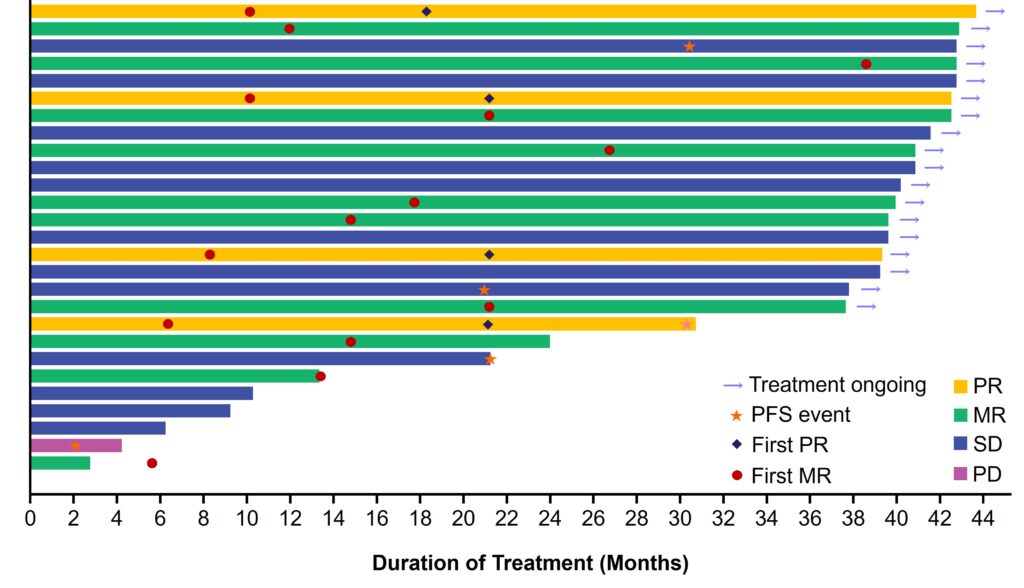
  • Responses were durable and, of the patients who responded, only one patient subsequently experienced PD per IERC at the time of data cutoff
  • Median TTR per IERC was 14.1 months (range, 5.6–38.7)
  • Median DOR per IERC was NR (95% CI, 24.0–NR)
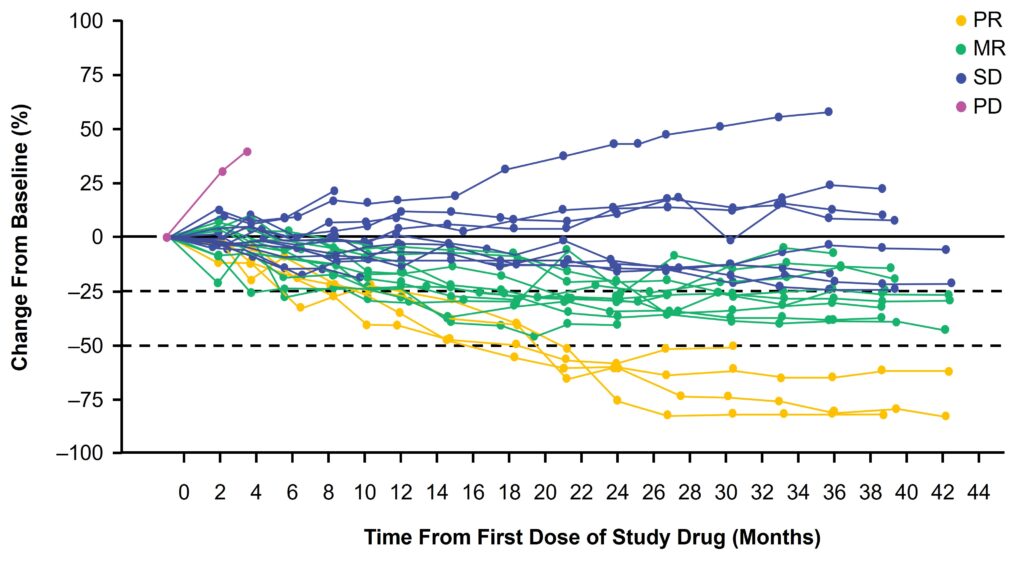
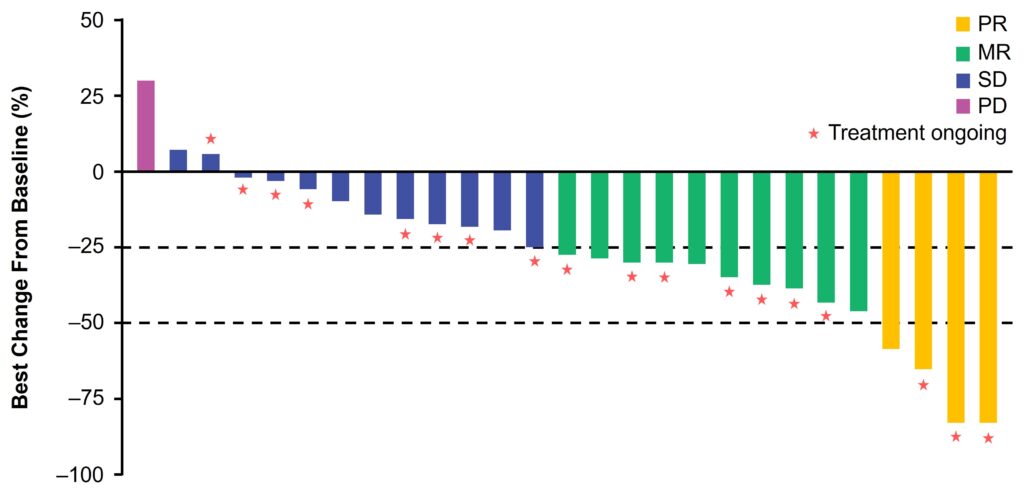
Safusidenib Demonstrated Sustained Disease Control
  • Among the 27 patients, the median best percent change in the SPD of the target lesions per IERC was -27.22% (range, –83.1, 30.2)

Data cutoff: March 14, 2024. Data shown per IERC.

  • The majority of patients were on treatment for >36 months (3 years), with treatment still ongoing at the time of data cutoff
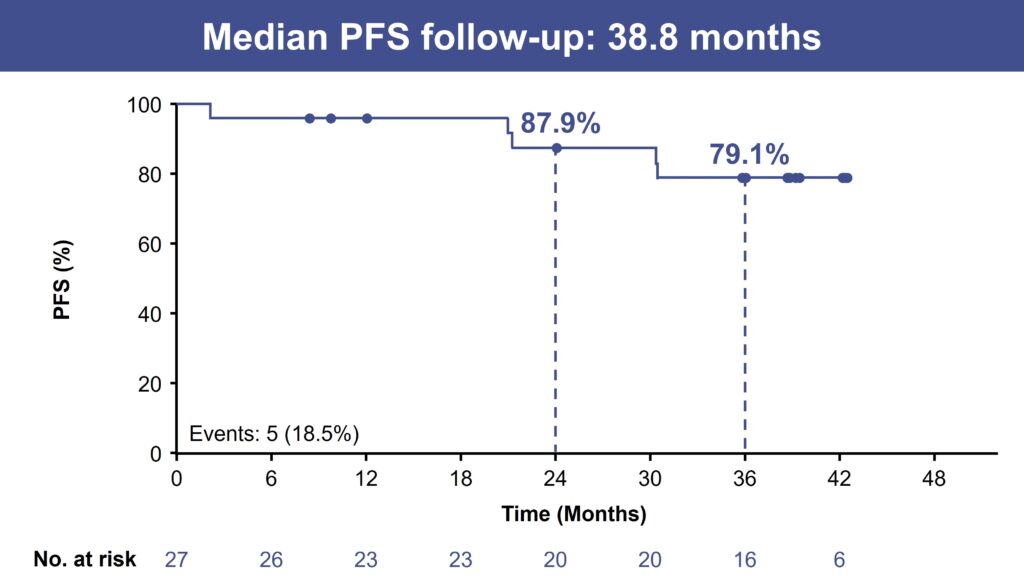
With Longer Follow-Up, Median PFS Was Not Reached
IERC Assessed (N=27) INV Assessed (N=27)
Median PFS, months (95% CI) NR (NR–NR) NR (NR–NR)
24-month PFS rate, % 87.9 84.5
36-month PFS rate, % 79.1 80.5

Data cutoff: March 14, 2024. Kaplan–Meier curve shown per IERC.

Safety

  • As of October 30, 2024, the median duration of safusidenib exposure was 46.7 months (range, 3–51)
  • With longer follow-up, the safety profile of safusidenib remained consistent with previous reports,5 with no new safety signals identified
  • Safusidenib demonstrated a favorable risk-benefit profile in patients with IDH1-mutant glioma, with TEAEs being mostly low grade and managed with dose modifications
  • The most common any-grade TEAEs were alopecia (59.3%), arthralgia (55.6%), skin hyperpigmentation (51.9%), increased ALT (40.7%), and rash (37.0%), which were mostly Grade 1 or 2
  • TEAEs resulted in dose interruptions in 74.1% of patients, dose reductions in 37.0%, and treatment discontinuations in 11.1%a
Common TEAEs With Safusidenib
Most Frequent TEAEs (≥15% of Patients), n (%) Any Grade Grade ≥3
Alopecia 16 (59.3) 0
Arthralgia 15 (55.6) 1 (3.7)
Skin hyperpigmentation 14 (51.9) 0
ALT increased 11 (40.7) 2 (7.4)
Rash 10 (37.0) 0
AST increased 9 (33.3) 1 (3.7)
Back pain 9 (33.3) 0
Pruritus 9 (33.3) 0
Neutrophil count decreased 8 (29.6) 0
COVID-19 7 (25.9) 0
Diarrhea 7 (25.9) 0
Nausea 6 (22.2) 0
Upper respiratory tract infection 6 (22.2) 0
Headache 5 (18.5) 1 (3.7)
Nasopharyngitis 5 (18.5) 0

Data cutoff: October 30, 2024. aThree TEAEs (11.1%) led to treatment discontinuation: two events of hepatic dysfunction and one of amnesia. Amnesia was deemed not related to study drug. The two treatment-related events of abnormal hepatic function were both resolved after hospitalization and treatment discontinuation.

Conclusions

  • With additional follow-up, safusidenib continued to demonstrate encouraging efficacy in patients with RT- and CT-naïve Grade 2 IDH1-mutant glioma, including durable responses and sustained disease control
  • The safety profile of safusidenib was consistent with prior reports, with most TEAEs being mild to moderate in severity and effectively managed with dose modifications, allowing long-term administration
  • These results suggest that safusidenib may represent a potential treatment option for patients with IDH1-mutant glioma who are not in need of immediate RT/CT

Abbreviations

ALT, alanine aminotransferase; AST, aspartate aminotransferase; BID, twice daily; BOR, best overall response; c, confirmed; CBR, clinical benefit rate; CI, confidence interval; CNS, central nervous system; COVID-19, coronavirus disease 2019; CR, complete response; CT, chemotherapy; DOR, duration of response; ECOG PS, Eastern Cooperative Oncology Group performance status; IDH1, isocitrate dehydrogenase 1; IERC, Independent Efficacy Review Committee; INV, investigator; KPS, Karnofsky performance status; MR, minor response; NR, not reached; ORR, objective response rate; PD, progressive disease; PFS, progression-free survival; PR, partial response; RANO-LGG, Response Assessment in Neuro-Oncology Low-Grade Glioma; RT, radiotherapy; SD, stable disease; SNO, Society for Neuro-Oncology; SPD, sum of products of diameters; TEAE, treatment-emergent adverse event; TTR, time to response; WHO, World Health Organization.

References

  1. Louis DN, et al. Neuro Oncol 2021;23:1231–1251
  2. Weller M, et al. Nat Rev Clin Oncol 2021;18:170–186
  3. Lanman TA, et al. Cancers (Basel) 2025;17:2630
  4. Machida Y, et al. Mol Cancer Ther 2020;19:375–383
  5. Arakawa Y, et al. Neuro Oncol 2026;28:717–727

Acknowledgments

We would like to thank all patients who participated in this study, the study investigators, and their staff. This study was sponsored by Daiichi Sankyo Co., Ltd. Medical writing support was provided by Lisa Alberts, MPhil, of Ashfield MedComms, an Inizio company, and was funded by Nuvation Bio Inc.

Explore our other publications