SIGMA: A Phase 3 Study Evaluating Maintenance Safusidenib vs Placebo Following Radiotherapy or Chemoradiotherapy and Adjuvant Temozolomide in Patients With Isocitrate Dehydrogenase 1 (IDH1)-Mutant Astrocytoma With High-Risk Features
Katherine B. Peters,1 Ankush Bhatia,2 Yoshie Umemura,3 Fabio Iwamoto,4,5 Ying Mao,6 Xiaohui Ren,7 Junping Zhang,8 James R. Whittle,9 Yuling Cen,10 Jianxin Wei,10 Piia Thomas,10 David A. Reardon11
1Duke University Medical Center, Durham, NC, USA; 2University of Wisconsin Health, Madison, WI, USA; 3Ivy Brain Tumor Center, Barrow Neurological Institute, Phoenix, AZ, USA; 4Stanford Brain Tumor Center, Palo Alto, CA, USA; 5Affiliation at time of abstract submission: Columbia University Irving Medical Center, New York, NY, USA; 6Huashan Hospital, Fudan University, Shanghai, China; 7Beijing Tiantan Hospital, Capital Medical University, Beijing, China; 8Sanbo Brain Hospital, Capital Medical University, Beijing, China; 9Peter MacCallum Cancer Centre, Melbourne, VIC, Australia; 10Nuvation Bio Inc., New York, NY, USA; 11Center for Neuro-Oncology, Dana-Farber Cancer Institute, Boston, MA, USA
Poster TIP-06
Presented at the Society for Neuro-Oncology Annual Meeting | November 12–15, 2026 | Philadelphia, PA, USA
For more information, please contact Dr Katherine B. Peters: katherine.peters@duke.edu
Jump to a section:
Background
- IDH-mutant astrocytomas are a distinct category of adult-type diffuse glioma per WHO CNS 2021 criteria, based on their unique molecular and clinical features1
- IDH inhibitors represent a paradigm shift in neuro-oncology, giving select patients with Grade 2 IDH-mutant glioma their first targeted treatment option2
- However, standard-of-care treatment for most IDH1-mutant astrocytomas remains maximal safe resection followed by RT/CRT and adjuvant TMZ2,3
- Although RT/CRT and adjuvant TMZ prolongs PFS,4 patients almost inevitably experience PD, at which point, salvage therapies are limited2
- For patients with IDH1-mutant glioma, high tumor grade and risk factors including contrast enhancement, residual tumor after surgery, and certain molecular features are associated with earlier PD and poor prognosis5–8
- There is, therefore, a clear unmet need for effective targeted treatments in IDH1-mutant astrocytoma that can delay PD after RT/CRT and adjuvant TMZ
Rationale
- Safusidenib is an investigational oral mutant-IDH1 inhibitor with high potency, selectivity, and blood-brain barrier permeability9 that has recently been granted fast track designation by the US FDA for treatment of IDH1-mutant glioma10
- Safusidenib demonstrated encouraging clinical activity and a favorable risk-benefit profile in patients with IDH1-mutant glioma in Phase 1 (NCT03030066) and Phase 2 (NCT04458272) studies11,12

- Additionally, safusidenib achieved encouraging responses in patients with IDH1-mutant glioma across histological grades and risk groups, including those with high-grade disease or tumor contrast enhancement11
- These findings support further evaluation of safusidenib in patients with IDH1-mutant astrocytoma with high grade or high-risk features following RT/CRT and adjuvant TMZ
Study Aim
- SIGMA (NCT05303519) is an ongoing, Phase 3, randomized, double-blind study evaluating the efficacy and safety of maintenance safusidenib vs placebo following RT/CRT and adjuvant TMZ in patients with IDH1-mutant astrocytoma with high grade or high-risk features13
- A preceding dose-finding part of this study established the RP2D of safusidenib as 250 mg BID
- An open-label, single-arm, exploratory cohort from this study is also ongoing to evaluate safusidenib in RT/CT-naïve patients with Grade 3 IDH1-mutant oligodendroglioma

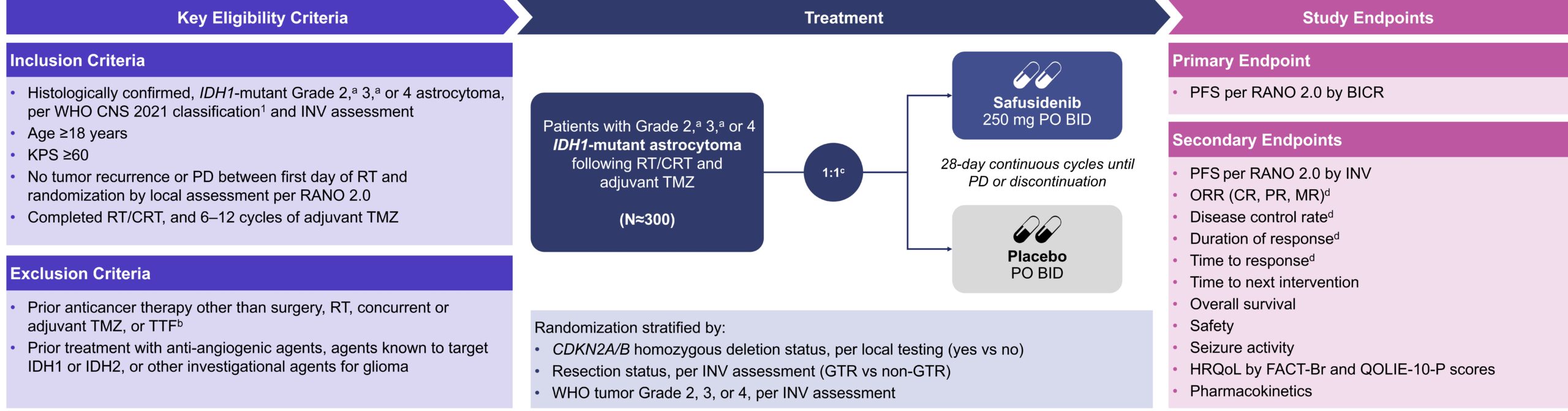
Study Design: SIGMA (NCT05303519)
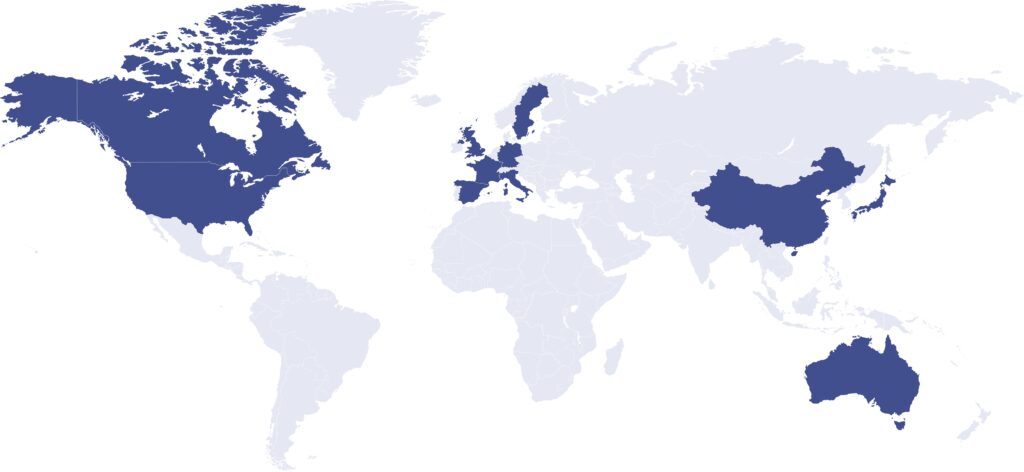
Trial Progress
Summary
- There is an unmet need for effective targeted therapies that delay PD and maintain quality of life in patients with IDH1-mutant astrocytoma following treatment with RT/CRT and adjuvant TMZ
- Safusidenib is an investigational mutant-IDH1 inhibitor with high potency, selectivity, and blood-brain barrier permeability that has shown encouraging efficacy in patients with IDH1-mutant glioma9,11,12
- The ongoing Phase 3, randomized, double-blind SIGMA study (NCT05303519) will evaluate maintenance safusidenib vs placebo in adults with IDH1-mutant astrocytoma with high grade or high-risk features13
Abbreviations
BICR, blinded independent central review; BID, twice daily; CDKN2, cyclin-dependent kinase inhibitor 2; CNS, central nervous system; CR, complete response; CRT, chemoradiotherapy; CT, chemotherapy; FACT-Br, Functional Assessment of Cancer Therapy-Brain; FDA, Food and Drug Administration; GTR, gross total resection; HRQoL, health-related quality of life; IDH1/2, isocitrate dehydrogenase 1/2; INV, investigator; KPS, Karnofsky Performance Status; MR, minor response; ORR, objective response rate; PD, progressive disease; PFS, progression-free survival; PO, orally; PR, partial response; QOLIE-10-P, Patient Weighted Quality of Life in Epilepsy Questionnaire; RANO, Response Assessment in Neuro-Oncology; RP2D, recommended Phase 2 dose; RT, radiation therapy; SNO, Society for Neuro-Oncology; TMZ, temozolomide; TTF, Tumor Treating Fields; UK, United Kingdom; USA, United States of America; WHO, World Health Organization.
References
- Louis DN, et al. Neuro Oncol 2021;23:1231–1251
- Lin MD, et al. NPJ Precis Oncol 2024;8:149
- Mohile NA, et al. J Clin Oncol 2022;40:403–426
- Van den Bent MJ, et al. Lancet Oncol 2021;22:813–823
- Swensen SN, et al. Curr Treat Options Oncol 2024;25:1594–1604
- Ostrom QT, et al. Neuro Oncol 2023;25:799–807
- Weller M, et al. Acta Neuropathol 2024;147:11
- Wang YY, et al. Am J Neuroradiol 2015;36:2023–2029
- Machida Y, et al. Mol Cancer Ther 2020;19:375–383
- Nuvation Bio Press Release. Accessed October 1, 2026; https://investors.nuvationbio.com/news/news-details/2026/Nuvation-Bio-Granted-FDA-Fast-Track-Designation-for-Safusidenib-for-Treatment-of-IDH1-Mutant-Glioma/default.aspx
- Natsume A, et al. Neuro Oncol 2023;25:326–336
- Arakawa Y, et al. Neuro Oncol 2026;28:717–727
- ClinicalTrials.gov. NCT05303519. Accessed October 1, 2026; https://clinicaltrials.gov/study/NCT05303519
Acknowledgments
We would like to thank all patients who are participating in this ongoing study, the study investigators, and their staff. This study is sponsored by Nuvation Bio Inc. Medical writing support was provided by Jane Blackburn, PhD, of Ashfield MedComms, an Inizio company, and was funded by Nuvation Bio Inc.