Our New FDA-Approved Treatment: Learn More

A Phase 2 Study Evaluating the Efficacy and Safety of Safusidenib in Grade 2 or 3 Isocitrate Dehydrogenase 1 (IDH1)-Mutant Glioma After Disease Progression on Vorasidenib

Macarena de la Fuente,1 John de Groot,2 Alexandra Miller,3 Yuling Cen,4 Piia Thomas,4 Katherine B. Peters5

1Sylvester Comprehensive Cancer Center, University of Miami, Miami, FL, USA; 2University of California, San Francisco, CA, USA; 3Langone Health, New York University, New York, NY, USA; 4Nuvation Bio Inc., New York, NY, USA; 5Duke University Medical Center, Durham, NC, USA

Poster TIP-09
Presented at the Society for Neuro-Oncology Annual Meeting | November 12–15, 2026 | Philadelphia, PA, USA
For more information, please contact Dr Macarena de la Fuente: mdelafuente@med.miami.edu

Jump to a section:

Background

  • IDH-mutant gliomas are a distinct category of adult-type diffuse glioma per WHO CNS 2021 criteria1
  • The standard-of-care treatment is maximal safe resection; in patients with Grade 2 and some patients with Grade 3 IDH1-mutant glioma, surgery may be followed by treatment with vorasidenib (an IDH1/2 inhibitor)2–6
    • Although vorasidenib has been shown to improve PFS and time to next intervention compared with placebo in the Phase 3 INDIGO trial, patients eventually experience PD7
    • Treatment options for recurrent glioma are generally limited to re-resection or RT/CT,8 which can be associated with substantial, long-term detrimental impacts for patients9
    • There is, therefore, an unmet need for effective targeted therapies that continue to delay PD and the need for RT/CT after PD on vorasidenib

Rationale

  • Safusidenib is an investigational mutant-IDH1 inhibitor with high potency, selectivity, and blood-brain barrier permeability,10 that has recently been granted fast track designation by the US FDA for treatment of IDH1-mutant glioma11
    • Safusidenib demonstrated encouraging clinical activity and a favorable risk-benefit profile in patients with IDH1-mutant glioma in Phase 1 (NCT03030066) and Phase 2 (NCT04458272) studies, including responses across histological grades and risk groups12,13
    • Safusidenib has also demonstrated encouraging clinical activity in patients with RT/CT-naïve IDH1-mutant glioma in the Phase 2 study (Table 1)11,13
    • Safusidenib remains active in models resistant to ivosidenib,14 supporting sequential IDH inhibition as a potential treatment strategy; in addition, safusidenib binds mutant IDH1 differently compared with vorasidenib and may work through a distinct mechanism of action10,15
    • Together, these findings support further evaluation of safusidenib for patients who experience PD on vorasidenib
Table 1. Phase 2, Open-Label Study of Safusidenib in Patients With RT/CT-Naïve Grade 2 IDH1-Mutant Glioma (NCT04458272)11
Endpoint N=27
Confirmed ORR, % 51.9
Median PFS, months NR
36-month PFS rate, % 79.1

Median PFS follow-up: 38.8 months.

Study Aim

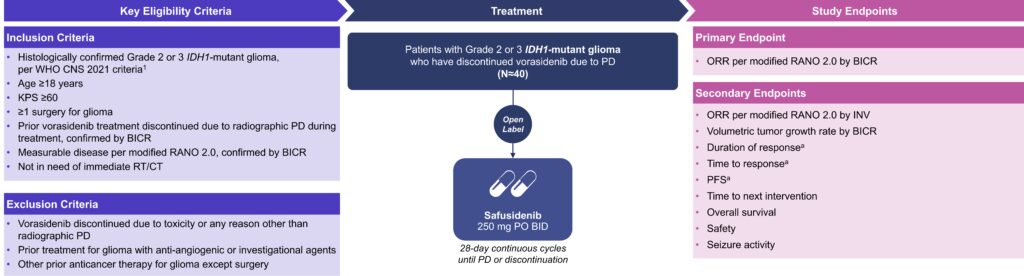
  • This ongoing, Phase 2, multicenter study (NCT07703436) is evaluating the efficacy and safety of safusidenib in patients with Grade 2 or 3 IDH1-mutant glioma who experienced PD following vorasidenib treatment and do not require immediate RT/CT16

Study Design (NCT07703436)

aBICR and investigator assessed, per modified RANO 2.0.
Trial Progress

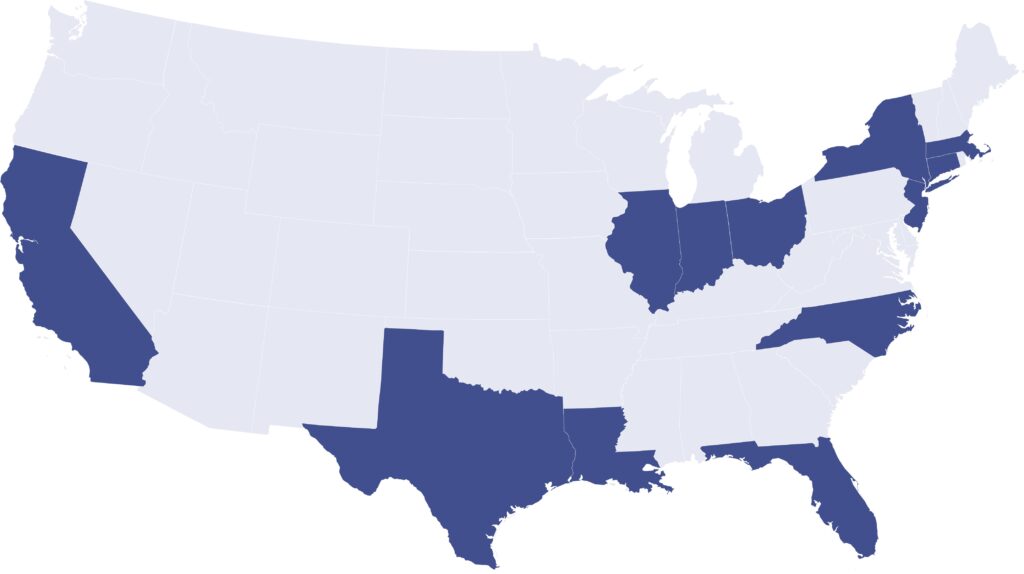
  • This Phase 2, multicenter study (NCT07703436) is ongoing, with 18 US sites selected as of October 2026


Summary

  • For patients with Grade 2 or 3 IDH1-mutant glioma who experience PD on vorasidenib, there is an unmet need for effective targeted therapies that continue to delay the need for RT/CT
  • Safusidenib is an investigational mutant-IDH1 inhibitor with high potency, selectivity, and blood-brain barrier permeability that has shown encouraging efficacy in patients with IDH1-mutant glioma10,12,13
  • This ongoing, Phase 2, multicenter study (NCT07703436) is evaluating the efficacy and safety of safusidenib in patients with Grade 2 or 3 IDH1-mutant glioma who experienced PD following vorasidenib treatment

Abbreviations

BICR, blinded independent central review; BID, twice daily; CNS, central nervous system; CT, chemotherapy; FDA, Food and Drug Administration; IDH1/2, isocitrate dehydrogenase 1/2; INV, investigator; KPS, Karnofsky Performance Status; NR, not reached; ORR, objective response rate; PD, progressive disease; PFS, progression-free survival; PO, orally; RANO, Response Assessment in Neuro-Oncology; RT, radiotherapy; SNO, Society for Neuro-Oncology; WHO, World Health Organization; US, United States.

References

  1. Louis DN, et al. Neuro Oncol 2021;23:1231–1251
  2. Blakeley J, et al. Neuro Oncol 2025;27:1412–1418
  3. Lin MD, et al. NPJ Precis Oncol 2024;8:149
  4. Mellinghoff IK, et al. J Clin Oncol 2020;38(15_suppl):2504
  5. Himstead AS, et al. Biomedicines 2025;13:201
  6. Dipasquale A, et al. J Neurooncol 2026;176:186
  7. Mellinghoff IK, et al. N Engl J Med 2023;389:589–601
  8. Weller M, et al. Nat Rev Clin Oncol 2021;18:170–186
  9. Blonski M, et al. Front Oncol 2022;12:827897
  10. Machida Y, et al. Mol Cancer Ther 2020;19:375–383
  11. Nuvation Bio Press Release. Accessed October 1, 2026. https://investors.nuvationbio.com/news/news-details/2026/Nuvation-Bio-Granted-FDA-Fast-Track-Designation-for-Safusidenib-for-Treatment-of-IDH1-Mutant-Glioma/default.aspx
  12. Natsume A, et al. Neuro Oncol 2023;25:326–336
  13. Arakawa Y, et al. Neuro Oncol 2026;28:717–727
  14. Reinbold R, et al. Nat Commun 2022;13:4785
  15. Konteatis Z, et al. ACS Med Chem Lett 2020;11:101–107
  16. ClinicalTrials.gov. NCT07703436. Accessed October 1, 2026; https://clinicaltrials.gov/study/NCT07703436

Acknowledgments

We would like to thank patients who will participate in this study, the study investigators, and their staff. This study is sponsored by Nuvation Bio Inc. Medical writing support was provided by Sean R. Mills, PhD, of Ashfield MedComms, an Inizio company, and was funded by Nuvation Bio Inc.

Explore our other publications